
KSRanked Part 2
The middle ten

Welcome to day 2 of my rankings for all Kim Stanley Robinson books. The first post can be found here. Previous Stanley spotlights can be found In my Love Letter and Addendum. As promised, I will do a list for the top ten tomorrow and then a final thoughts/retrospective around the end of the week. After that, I will do my best to talk about other authors and genres for a few months (or at least weeks if I’m desperate). Enjoy!
20: Galileo’s Dream (2009)
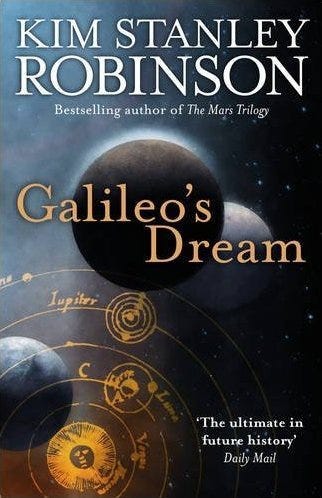
Science Fiction, Speculative Fiction, Alternate History
Awards: John W. Campbell Finalist, 3rd for Locus Best Science Fiction Novel 2010
We are starting the list today with a very unusual KSR. Normally, his books have only grounded science fiction with technologies and events that could plausibly grow out of the present day. Galileo’s Dream is packed full of time travel, aliens, and science that mirrors magic. It might be more accurate to say that the technology more closely mirrors religion, as the plot for this book sees Galileo Galilei repeatedly visited by time travelers and brought into the future to settle a dispute of scientific dogma in the far future. The conflict between twisted science as a secular religion and Galileo’s own persecution by the church play off each other well, but the star of the book is Stanley’s loving portrayal of the crochety old scientist himself. Galileo is full of wit, emotion, and character the whole way through and I found the sections in the past to be the best in the novel. Similar to the Years of Rice and Salt, there is a palpable feeling of love for the world in Stanley’s writing of early scientists. It is a joy!
Moments of Being: Epiphanies on the stars with Galileo alone at a telescope, Time Travelers of futures past, grumpy old men, tunneling into the moons of Jupiter.
19: Fifty Degrees Below (2005)
Science Fiction, Speculative Fiction, Environmental
The second Science in the Capital book that I read as a part of Green Earth. I think it is an improvement over the first in every way. The characters are stronger and allowed to do more. The scope is wider and to show interdepartmental cooperation, the start of a political movement, and a feeling of hope. And the tone settled into something I could have fun with: serious climate fiction for all characters except Frank (who lives in a soap opera). I really enjoy the feeling of time passing in this book both as a vehicle to grow the larger movement and simply to sit outside and watch the seasons change.
Moments of Being: Sleeping in a treehouse as an adult, playing frisbee with the bros, am I dating a Fed?, did a monk isekai my baby?
18: A Short Sharp Shock (1990)
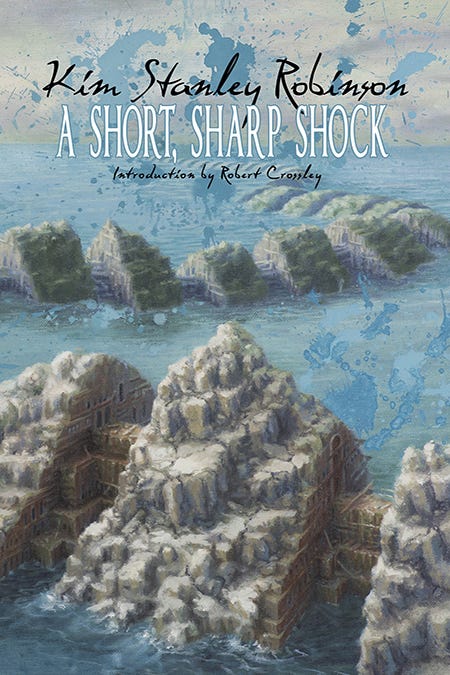
Fantasy
Awards: Locus Best Novella award for 1991
A Short Sharp Shock surprised me. It breaks the KSR mold even more than Galielo’s Dream because this is full Fantasy. There is no pretext of plausibility or even rational grounding. Instead, Shock goes all the way on symbolism and implication over believability. For the most part chapters are short as the main character moves from island to island in a chain that extends off over the horizon. Each island is different and offers different challenges. Is it a metaphor for life? Death? Dreams? Reincarnation? A relationship? Probably yes to all. I was satisfied and enjoyed there not being a clear central metaphor. Instead I was seeing many different meanings moment to moment because the writing had enough there to support them. As with the Buddhist themes in so many of his books, I think that is an especially insightful lens to use when reading.
Moments of Being: Lady with two heads, almost drowning, mirrors/doubles/alters/twins/shadows galore.
17: Sixty Days and Counting (2007)
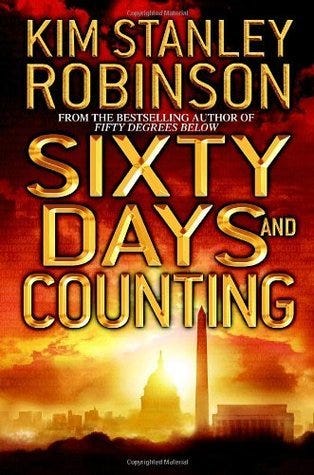
Science Fiction, Speculative Fiction, Environmental
The final Science in the Capital book combined into Green Earth. Again, this was an improvement and continued the trend of increasing scope. Now we are showing international cooperation and efforts to shift society down a new path. The soap opera is also escalating, with love triangles obliterated and commitments made. Frank continues to make odd choices but in this book his POV has coalesced into a complete view of a complicated character that has changed in some ways and worn deeper grooves into other old habits. I like him unironically with no need to qualify.1 I would happily read a fourth book and plan to reread the series in the unabridged originals for whatever scraps I can get.
Moments of Being: A US President with a blog, Kayaking, searching your mate for bugs (electronic), moderate brain damage.
16: Pacific Edge (1990)
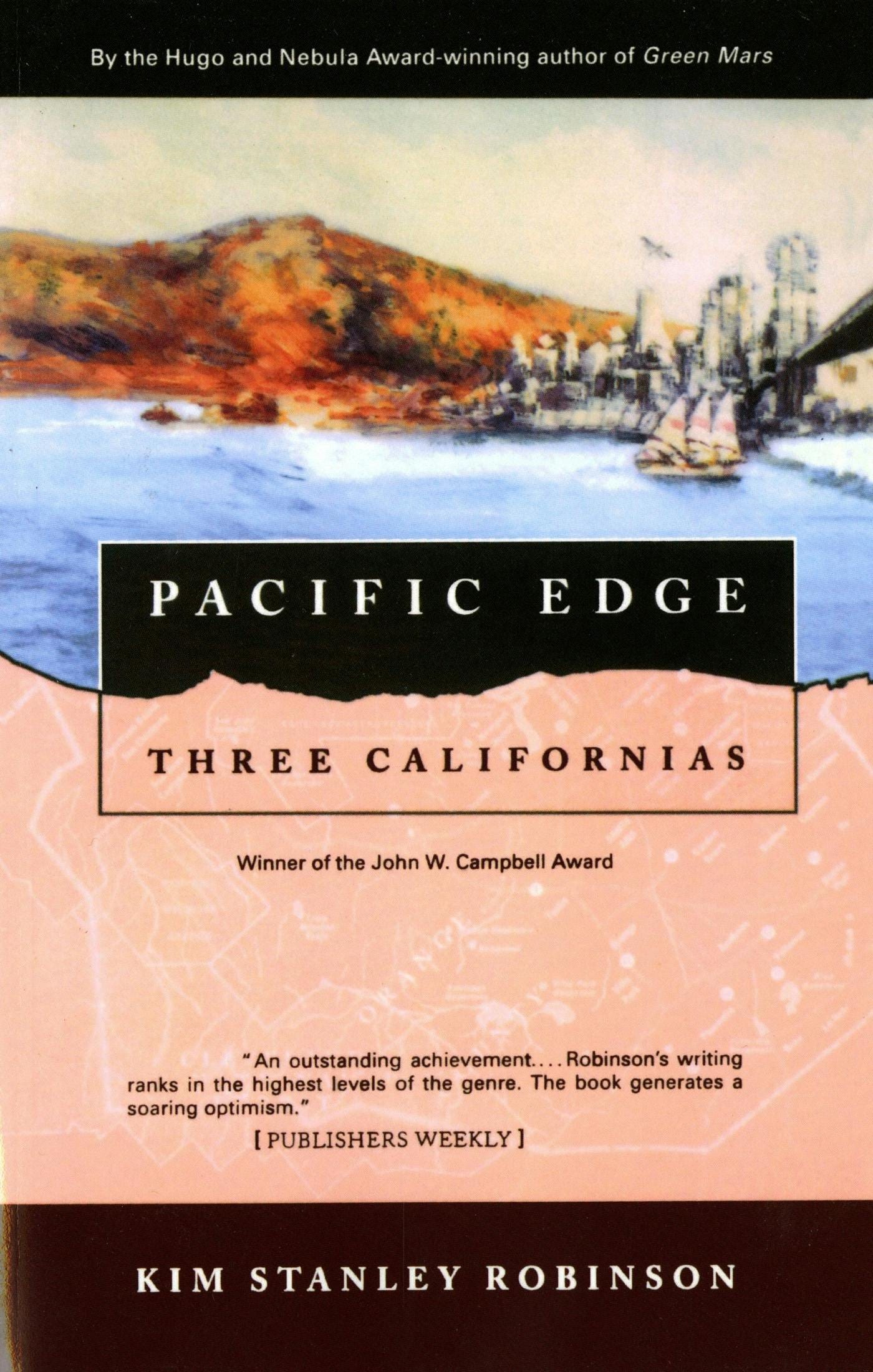
Science Fiction, Speculative Fiction, Alternate History, Utopian
Awards: Winner of John W. Campbell Award 1991
This is another of the Three California books, and for a change shows what would happen if everything goes right. This is the clearest example of a Utopia in a KSR book. It still has some rougher edges, but for the most part Climate Change is being reversed, the non-violent revolution happened and Capitalism lost, and the biggest problem in the lives of the characters is a land development project they oppose. Pacific Edge shows that even when a book starts in utopia, people will still live interesting lives. There is always a story to tell and utopia will only give more people the chance to make their own meaning.
Moments of Being: Baseball, flying bicycles (don’t ask me to explain the physics of that one), and local politics.
15: Green Earth (2015)
Science Fiction, Speculative Fiction, Environmental
I believe that Green Earth is better than it’s individual parts. Book by book the story and characters got better and I grew more attached in a way that turned the length, which I expected to dislike and pushed Green Earth to be the absolute last KSR novel I read, into a strength. The many seasons spent with Frank and the others feels impactful and when I was nearing the end I was sad to see them go after a thousand pages. I wanted the next book to start and for the great blue Earth to spin on.
Moments of Being: Soap Opera but with scientists, seasons passing, triple wedding.
14: The Memory of Whiteness (1985)
Science Fiction, Speculative Fiction, Philosophical
This was Stanley’s third published book, and the book that followed Icehenge. I started reading Memory with a lot of hope for the follow up to be just as good. I wasn’t disappointed, but it still wasn’t what I expected. Stanley had it all planned out from the start however. This is book which takes place farthest into his timeline, and provides a overview of the whole history, consistent with Icehenge before it, and Mars, 2312, and beyond after. Again, this all started in the early 80’s. The consistency is impressive and thematically resonates within Memory itself which explores determinism and the nature of reality through heady discussions.
The discussion is about physics and metaphysics, but also about music. The main character is the most recent conductor of a one-of-a-kind incredible invention which allows a single person to replicate the feeling of a full orchestra. Structurally, the plot is one long tour as Wright moves inward from Pluto to play music at every planet along the way to the sun. At each stop, he and his new friends are pulled deeper and deeper into a plot which will force him to question free will itself. Who is conducting this show after all? The music and physics go well together, the tour structure creates a nonstop flood of interesting worldbuilding, and the writing is beautiful throughout. I am most conflicted on the ending, but even that has stuck in my head and remained wort thinking about month slater. Great book!
Moments of Being: Concerts that cause riots, conversation about art and metaphysics with a new best friend, villains with a secret lair puppeteering other puppet masters.
13: Shaman (2013)
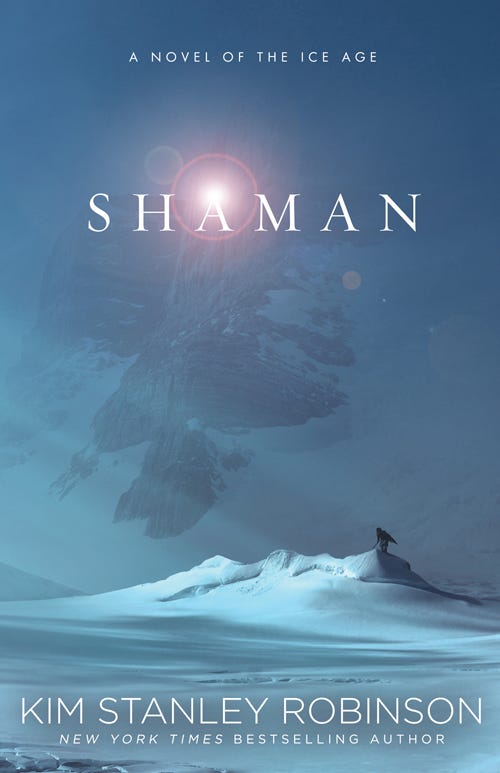
Speculative Fiction
Awards: John W. Campbell finalist 2014, Locus Award best Science Fiction Novel 2nd place in 2014
I have a soft spot for this book because I read it first from my tent while taking campers on a week long backpacking trip. All day I was walking and being responsible for children’s safety, and reading Shaman at camp was the perfect evening activity. The book is often about endurance and traveling long distance, and taught me the mantra of the Third Wind.
I am the third wind
I come to you
When you have nothing left
When you can't go on
But you go on anyway
In that moment of extremity
The third wind appears
And so it is I come to you now
To tell you this story
Luckily the book is great all on it’s own. This is KSR exploring what life would look like during the ice age. I think he does a great job depicting prehistoric life, both because it is well researched and in the sense of dignity an vibrancy his tribal life has. He is able to make people without metal tools seen intelligent, curious, capable, and recognizable. Their stories are exciting and compelling and my immersion was never broken. As often is the case, where another author would make a point to create a dark and brutal point, Stanley tells a human story. Everything else flows from that.
Final thought: Loon is an all time great name for a coming of age story protagonist and I challenge anyone to name a better one.
Moments of Being: distance running, communal living, storing nuts for winter, storytelling.
12: Stan’s Kitchen (2020)
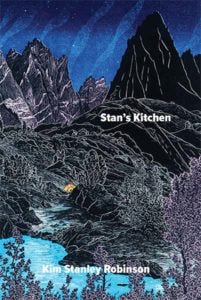
Non-fiction, Short Story Collection
I saved Stan’s Kitchen to be the final KSR book on my shelf. It is a selection of short stories, essays, speeches, and poems that Stanley selected to be published together by a local Boston Science Fiction community when he was honored at their annual convention. I didn’t know that happened until years late unfortunately. Regardless, I knew Stan’s Kitchen would be a great celebration or at least companion for his career. The man himself had edited to act as such.
All but one of the short stories I had read previously, so the real joy was in the essays. After finishing his novels and getting immersed in his short story work I appreciated more how many literary influences Stanley pulls from, but this book does even more to show how much he cares and thinks about the genre. From discussions on being anti-anti-utopian to his experience learning from LeGuin. This is a perfect love letter to Science Fiction.
Moments of Being: Get a bigger TBR with recommendations and criticism from one of the best, Stanley tells all about LeGuin (they saw Star Wars for the first time sitting next to each other), poems and anecdotes abound.
11: Three Californias (2020)
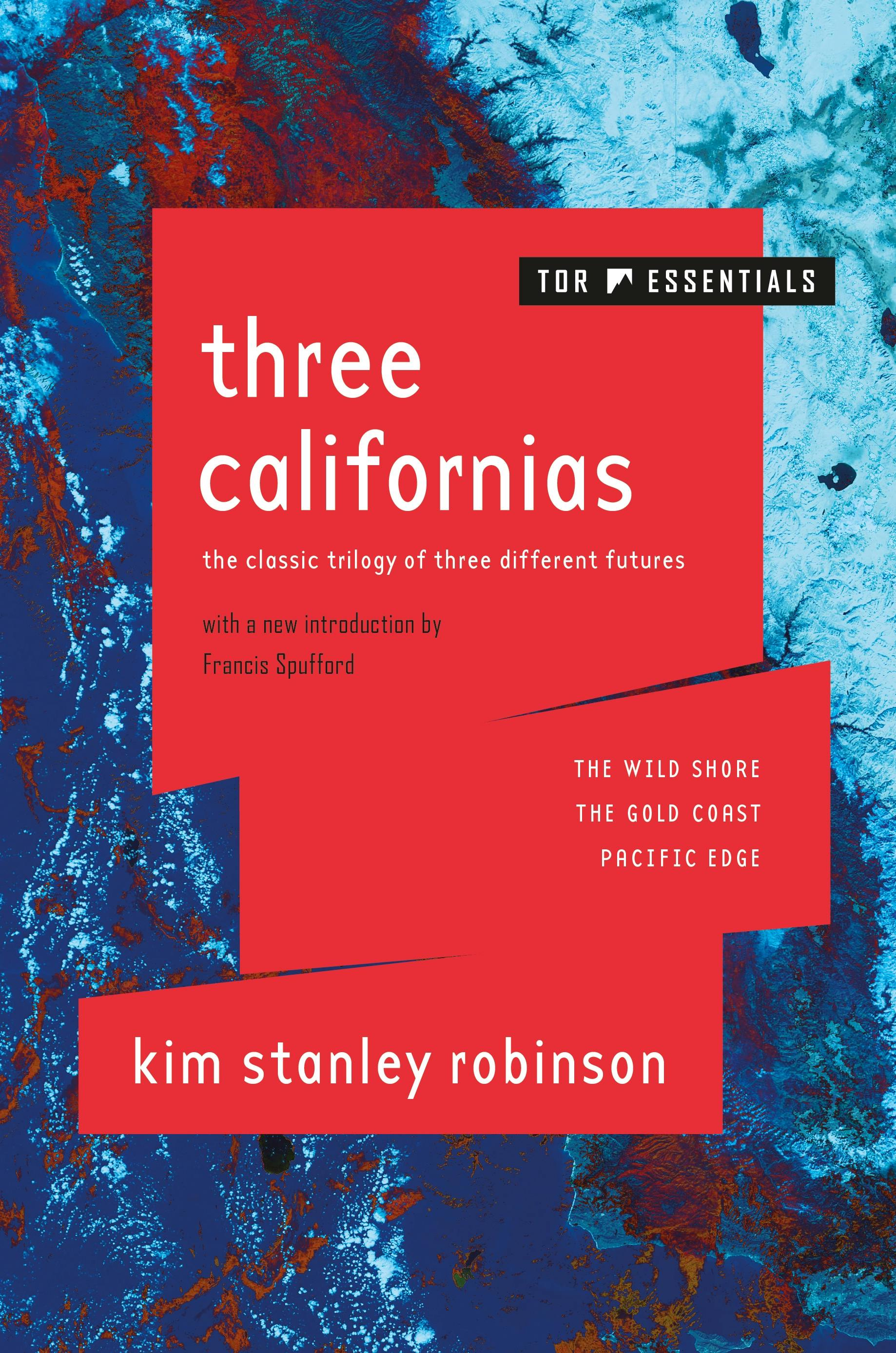
Science Fiction, Speculative Fiction, Alternate History, Dystopian, Utopian
Much like Green Earth, I find Three Californias to be better than the novels contained within. This time, I find it better than a simple trilogy. Stanley uses the word triptych for the books because the three alternate worlds are not meant to follow each other, they are meant to be analyzed alongside each other and change the understanding of the whole. They are in conversation with each other as much as the reader. Very ambitious from a young author (but then again he put out Icehenge right after Wild Shore).
The triptych also are a great microcosm for many of the themes that would appear across his full career. The difference between disaster and utopia in progress, environmental radicalization, a focus on humanism, and even the dual face of science fiction and alternate reality. All topics Stanley would revisit across decades.
Moments of Being: cozy radioactive farming sim, blood for the money machine, and local politics in paradise.
What’s Next?
Get ready for day 3! The top 10 is almost here. Please ask questions or share thoughts. I am starting to cover books that I know a few of my readers have read. More to come!
Easily a top 2 KSR character named Frank. Not sure if he beats Chalmers.